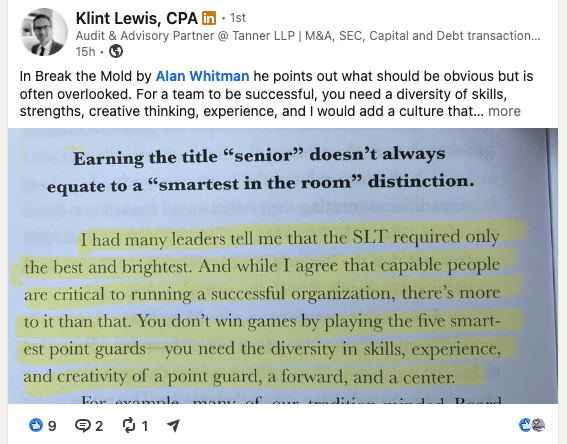
I'm appreciative of those who go out of their way to share a lesson they've learned from my book. Thanks to Klint Lewis, CPA, for the recent shoutout.
I've distilled all of my growth, scaling, and transformation principles into one tactical guide—told through the lens of storytelling from my real-life CEO experiences. Order my book, Break the Mold: How to Achieve Transformational Change, Scale, and Growth Simultaneously, today on Amazon.
The tale of two fishermen.
Let's say there are two fishermen fishing in the same pond.
For years, you couldn't tell them apart.
Both showed up at the same dock, both pushed off at the same gray sunrise, and both came home with full buckets.
Ask either one how the day went, and you'd get the same easy answer: "I always catch fish."
But they were not the same fisherman.
The first one caught fish because the pond was packed with them. It was so full that he could cast almost anywhere, with almost anything on the line, and pull one in. He never had to learn much, so he never did. Why would he? The bucket filled itself.
Over time, he came to believe he was simply a great fisherman.
The second one caught just as many, but he went about it completely differently.
He studied the pond. He learned which fish held near the reeds and which ran deep, and how that shifted from spring to fall. He knew which lure to tie on in cold water and which to use once it warmed, at dawn versus dusk. When the fish moved, he moved with them.
For years, the two buckets looked identical. Both men said, "I always catch fish."
Then the pond changed.
Maybe it was a hard winter. Maybe the big schools thinned out or moved on. Maybe it was something nuanced about fishing that I don't know because I'm not a true fisherman. Whatever the cause, casting blindly stopped working.
So the first fisherman stopped catching fish. But he had always caught fish, so what happened? He'd never known why they were biting, so now that they'd stopped, he had no idea what to change.
The second fisherman adjusted. He changed his lure, worked a different depth, tried a new stretch of shoreline. He kept catching fish because he had never depended on the pond being full or the fish being in the usual places. He depended on knowing how to fish.
Both men had always caught fish. Only one of them actually knew how.
I think about those two fishermen every time I hear a company say, "We've always grown."
When people say this, it's usually true! Revenue has climbed year after year, and they're proud of it — as they should be. But "we've always grown" doesn't tell me whether anyone on the boat knows how to fish, or whether the pond has simply been generous.
And you only find out which one you are when the pond changes. When a big client gets acquired. When referral sources dry up. When the economy softens, and the work that used to find you slows down.
As the old saying goes, everybody has a plan until they get punched in the face.
Then you learn the difference between the companies that simply grew as a result of good fortune (or more often, a lot of referrals) and those that grew because they actually knew how.
So what does "knowing how to grow" look like?
It looks like having a defined, documented, and distributed strategy that's differentiated. It looks like setting intentional targets, building a pipeline, and measuring the activities that create results. It looks like building engines that do things for, with, and in spite of people, so the critical activities carry on no matter what.
In our case at Nichols Cauley, it means tracing a clean line from the action to the outcome.
I make this call, it creates an introduction. I run this email campaign, it creates an opportunity. I post this content on social media, it generates these leads. I execute a follow-up system on open opportunities, it produces predictable revenue.
We're plotting what metrics we need to hit to make our month, quarter, and year, then determining the activities, systems, and changes needed to achieve it.
Let me give you an example of what this mindset shift looks like in practice.
I once had a talented professional who was buried in billable work. Exactly the kind of person most companies would never dare pull off the line, because every hour he spent not doing the work looked like lost revenue. But he had a real gift for building relationships and creating opportunities.
So we took him off the line and pointed him at growth full-time in a sales and business development role where he enabled sales across different business lines.
There was a lot of pushback... "How could we pull him off the line when he's producing???"
In the new role, he created email lists, messaging, automated follow-up sequences, and tied it all to CRM tracking. These are all engines that make growth more predictable. Instead of operating as an individual, he started enabling others.
These are all examples of knowing how to grow. We weren't sitting back and waiting for opportunities; we were intentionally creating them.
From growth by result to growth by design.
So here's the question I'd leave you with: if the market shifted and the work stopped coming to you, would your company continue growing at the same rate?
If the answer is yes, you've built something durable and sustainable. Stay with it. You're growing by design.
And if the answer is no, that's not necessarily a failure (especially if you're growing). It's an opportunity to turn that growth into a predictable result through systems and engines that create and capture new demand.
Getting clear on how to intentionally and systematically grow is the most important work your leadership team can start on today.
With intention,
Alan Whitman
CEO at Nichols Cauley