The cost of doing nothing.
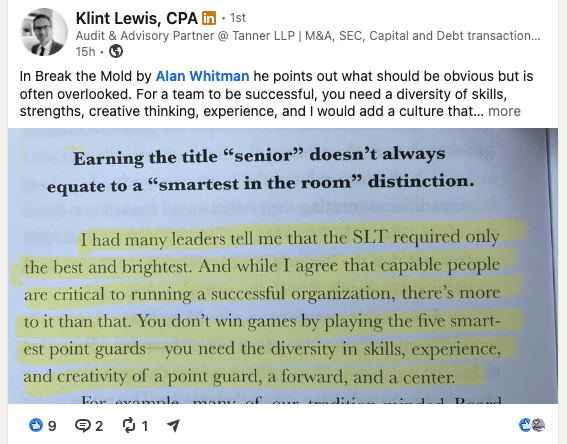
I'm appreciative of those who go out of their way to share a lesson they've learned from my book. Thanks to Klint Lewis, CPA, for the recent shoutout.
I've distilled all of my growth, scaling, and transformation principles into one tactical guide—told through the lens of storytelling from my real-life CEO experiences. Order my book, Break the Mold: How to Achieve Transformational Change, Scale, and Growth Simultaneously, today on Amazon.
When I told Lacey Goggans, CPA, our assurance services lead at Nichols Cauley, that I wanted to send her to a program at Harvard Business School and what it would cost, her immediate reaction was:
“That’s expensive!”
She wasn’t wrong. It was a five-figure investment.
From my experience, it’s common for leaders in professional services to look at investments in people as expenses. They look at price tags and then immediately go to the budget and say:
“Can we afford to develop this person?”
And many times, the answer defaults to “no”. But I’d suggest that’s the wrong mindset, and the wrong question because it’s focused purely on the cost.
So I ask a different question: what does it cost us if we don’t invest in their development?
And the answer to that question is far more worrisome than a line item on a budget.
Lacey’s path to leadership.
Lacey was recently elevated to a role leading a service line: our assurance services business. She absolutely earned it. She’s a great auditor and expressed interest in stepping into a leadership role.
AND being a great auditor (or a great practitioner of another kind) isn't necessarily the same as knowing how to lead and run a business. Those are two different mindsets, and two unique skill sets. So, in Lacey’s case, I saw an opportunity to help her develop into an even greater business leader — to go beyond her ability to do the work and to influence people and scale her impact in our company.
It’s also important to note that she had demonstrated a clear interest in learning the business side of things. She was eager to grow as a professional and to personally develop in new ways, so this was a natural progression for her.
Acceleration is the name of the game.
I want to be clear about something: Lacey is a very talented individual, and it’s likely that over time in her new leadership role, she would have grown into a well-rounded business leader.
Which, by the way, is usually the default approach… let a new leader figure out leadership the way most of us did, through osmosis. By paying dues over five or ten years until every mistake has been made at least once and learned from.
While that path might feel like a lower “cost” path from a pure financial standpoint, I’d suggest there’s an immense cost associated with this method: time.
Every year Lacey spends learning leadership through experience and osmosis is a year she’s leading a key service line without executing at her highest potential for the people she’s leading. What is lost in the equation is time and the power of compounding.
So we did the intentional thing: we accelerated her development.
Choosing the right leadership development opportunity.
The program I had in mind for Lacey was Leading Professional Services Firms at Harvard Business School. I’d been through it myself, so I knew it was uber valuable, and one of the most impactful development experiences of my career.
Could I have found something cheaper? Sure. But I sent her to what I believed was the best one on purpose, because if you decide to invest in someone, you invest in them.
And I sent her early, on purpose. Typically, nobody went to this program unless they were already a managing partner or a CEO — a reward for time served. I sent a young leader who had just stepped into the role, because I wanted her to have those skills at the start of the journey, not at the end of it.
I didn’t get these skills until I was a managing partner, and it would have been worth a fortune to have them five years earlier. I wanted Lacey to get that benefit earlier than I did, so she can put those learnings to work now and let them compound for the rest of her career.
Fast forward to today, and Lacey has completed the program at HBS. I’m already seeing the difference. I can watch her mind working in a different way than it did just a few months ago and the decisions she makes now, as a result of that program, will build on themselves over the years to come.
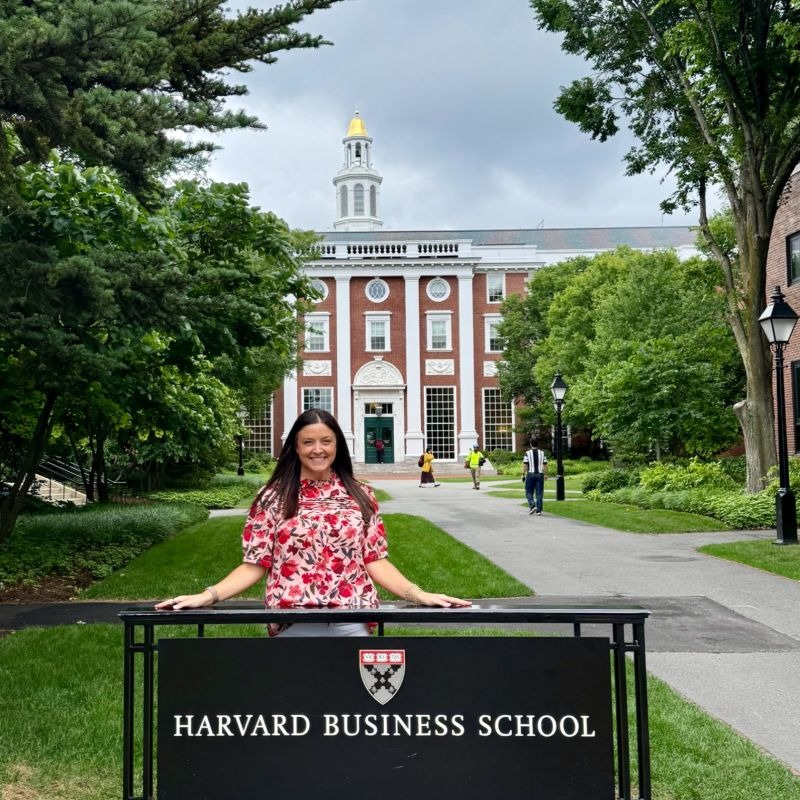
Way to go Lacey!!
A different way of viewing the math behind people development.
So let’s come back to cost.
If I’m not willing to make an investment in someone leading a significant part of our business, what does that say about the company? That we’ll put someone in a critical leadership role, but won’t invest in whether they actually succeed?
And consider what had already been invested in her. Years’ worth of projects, repetitions, and review notes that made her a great auditor — so why are we not willing to spend to make her an even greater leader, especially if that’s what she wants for her career?
Although I’m using an example with a bigger budget, intentional development can start much simpler, too. You could begin by spending an hour per month intentionally sitting down and understanding your direct reports, wherever they sit in the company. How do they want to grow? And how can you identify opportunities to support their growth?
Those seemingly small developmental and coaching moments add up to something meaningful.
So before you decide someone’s development costs too much, run the other number. Add up what it costs when you promote a good person, hand them something big, and then leave them to figure it out alone. What's the cost of doing nothing?
That’s the real cost at stake here.
So develop your people, be intentional about it, and consider the cost of doing nothing.
With intention,
Alan Whitman
CEO at Nichols Cauley
Whenever you're ready, here are 3 ways to engage with me, my content, and what we're building at Nichols Cauley:
Follow me on Linkedin for daily posts on leadership, thinking differently, and building a company in public.
Buy my book, Break the Mold, to read in depth about how to apply my principles to achieve transformational change, growth, and scale simultaneously.
Join us on the journey: View career opportunities at Nichols Cauley and join on us as we build something really special.