The accounting profession isn't dying.
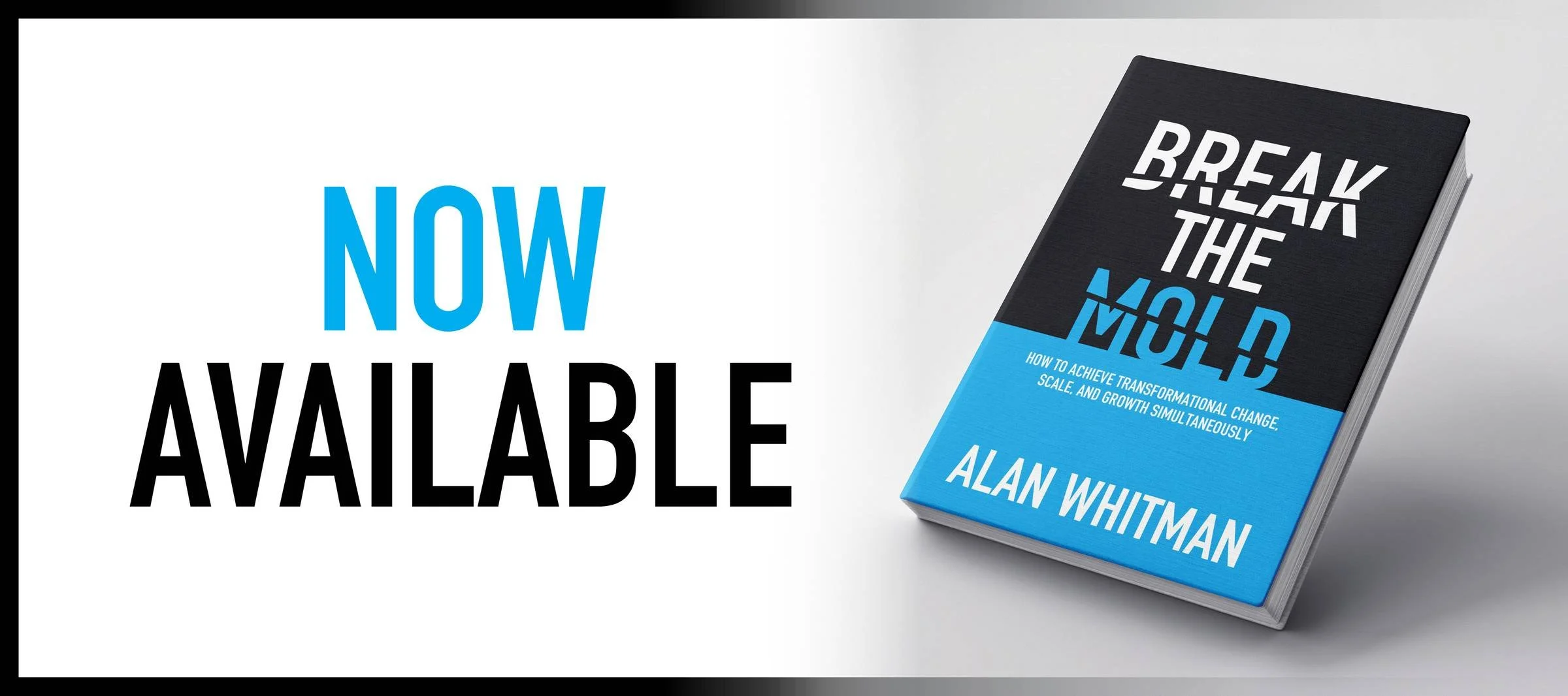
I've distilled all my growth, scaling, and transformation principles into one tactical guide—told through the lens of storytelling. Order my book, Break the Mold: How to Achieve Transformational Change, Scale, and Growth Simultaneously, today on Amazon.
The accounting profession isn’t dying—but there’s a new career path emerging
A friend (I call him A-Rod) asked me a question recently that I believe is on the minds of everyone in the accounting profession and anyone thinking about entering it.
His daughter, Emma, just finished a couple of internships at CPA firms. Now, she’s about to start her first full-time gig.
"Alan, is Emma going into a profession that's going to be disintermediated, or that's going to be gone in five years?"
It's a fair question. As exciting as AI and technology are, there’s also a lot of fear around these tools replacing the humans that have been the backbone of our noble profession.
So let me give you the same answer I gave him.
No. I don't think the job is going to be gone, and I don’t think the accounting profession is in jeopardy. That said, this is a BOTH/AND. The way Emma (and everyone else entering the profession) does her job is going to be different. Very different.
From doing to learning
What's going away is the lower-level, repetitive work.
The 500 1040s. The basic reconciliations. The grind that used to fill a young associate's first three years.
Should a young person sit and do 500 tax returns to learn the trade? No. Not anymore. Well, actually, they never should have, but that’s beside the point…
That repetitive and production-oriented work is going to automation. And it should!
For my whole career, that production had a job to do. It was work that needed to get done so the firm could recognize the revenue and bill for it. So the production was the main objective, and the learning was a byproduct.
Not a great employee development experience...
Today, the production is no longer primary. If we can use AI and automation to perform the same work without human intervention (or at least minimal intervention), we can’t bill time and materials like we used to. So the revenue model shifts to outcomes-based pricing.
Well, since we don’t count on young people entering the profession to recognize revenue and bill for their time, the production is no longer the main objective.
What is it instead? Learning.
And that changes the career path.
The new career path
Throughout my career in accounting, I climbed an escalator.
You know the one… time and grade. One step at a time, in a very sequential way.
Repeat as many production-oriented tasks as possible until you hit certain time markers and get called up to the next rung. And the escalator is slow. You stand on it, you put in the years, and eventually it carries you up.
Emma can't ride that escalator. She has to take the stairs… and take them two and three steps at a time.
She's going to have to learn far more quickly than I did, so she can get through the work that's about to be automated and reach the level that won't be: the judgment work.
Advisory. Relationship building. Connecting the dots. That's the level that's safe, and that's where the value is going to live.
Years ago, Mark Mendola — former PwC US MP during the time I was running Baker Tilly — said something to me that I’ve never forgotten:
"The firm that goes from production to outcomes will win."
He was talking about firms, but the same is true of the person. The employee who goes from production to outcomes will win. What does winning mean? Staying relevant in the profession, growing, and building a sustainable career.
So how does a young person actually get there faster? We go back to something old.
Welcome back, apprentice model
Early in my career, I’ll never forget my experiences following John DiStefano around to meetings and just listening. I was like his shadow, and my job (whenever I had a break from the production-oriented work) was to observe him and learn. I’ll tell you one thing… I learned more shadowing John than I ever learned grinding out returns.
Somewhere along the way, we stopped doing that. We got so focused on production, on hours, on getting the work into the system — the very work a machine can now do — that we cut the apprenticeship out.
It’s coming back. It has to.
I have a senior partner at Nichols Cauley who asked me what his role is in this new company we're building. I told him: keep doing what you're doing, and bring a young professional to every meeting.
The thing is, we have to accept as leaders that time spent shadowing is not downtime. It's not unproductive time. It's an investment in teaching and an example of intentional development in action.
“But Alan, how can we afford that? They aren’t producing anything!”
The margin we gain from automation is what pays for it. The machine does the 500 returns. The savings fund Emma to follow her mentor around and learn. That shadowing is how Emma leapfrogs — taking the stairs two and three at a time instead of standing on the escalator for years.
So there's still a pathway to senior leadership, to partner. It hasn't disappeared. It's just going to be walked a different way. And it's going to take intentionality.
Emma is going to have to take her career into her own hands far more than I did. Every piece of work has to be a learning experience, a way to upskill yourself. Quantity for its own sake is exactly what we're handing to the machines.
I recognize that this is another big, uncomfortable shift. I sat with a room of senior leaders in our company the other day and watched their gears grind, because it's such a different way of thinking. It makes sense to them, but understanding and doing are two different things.
This is going to require people to slow down to speed up. To train a different muscle than the one the profession has been built on over the last few decades.
And I'm a believer that we can and will do it.
Bottom line
So, no — I don't believe this noble profession will be gone in five years.
I do, however, believe the work and the career pathway are going to look a lot different than the ones I walked.
It's going to take young people being intentional about their own development from day one. Taking the stairs while everyone else waits on an escalator.
That's the future ahead of the people entering our profession.
And from where I sit, it's a better one. Emma's generation gets to skip the part of the job most of us couldn't wait to leave behind. They get to do the work that matters more, sooner.
If they're willing to climb.
With intention,
Alan Whitman
CEO at Nichols Cauley
Whenever you're ready, here are 3 ways to engage with me, my content, and what we're building at Nichols Cauley:
Follow me on Linkedin for daily posts on leadership, thinking differently, and building a company in public.
Buy my book, Break the Mold, to read in depth about how to apply my principles to achieve transformational change, growth, and scale simultaneously.
Join us on the journey: View career opportunities at Nichols Cauley and join on us as we build something really special.